|
|
Prises
de position - |
|
|
Prises
de position - |
No to U.S. aggression against Venezuela!
No to U.S. imperialist domination over Latin America!
Unity of the proletariat against imperialism and all bourgeois states!
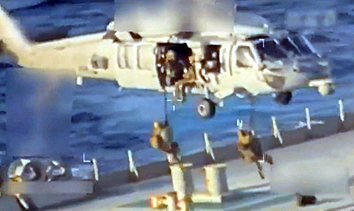
As we write these lines, we do not know whether the United States will carry out its threats and invade Venezuela. But the closure of Venezuelan airspace, the seizure of an oil tanker, and economic sanctions already constitute an aggression against that country; likewise, the killing on the high seas of nearly 100 alleged drug traffickers, by the fire of heavy aerial and riverine artillery concentrated off the Venezuelan coasts, is an act of war — claimed as such by the U.S. government: the “war on drugs.”
The aggression against Venezuela, orchestrated under the auspices of the eternal candidate for the Nobel Peace Prize, Donald Trump, is part of a renewed aggressiveness of U.S. imperialism toward Latin America: threats to send troops into Mexico, to seize the Panama Canal, deployment of soldiers in Ecuador, threats against the Colombian government, blatant interference in elections in Honduras and Argentina, the use of tariffs to try to influence Brazilian domestic policy, etc.
 This
aggressiveness is also exercised to the detriment of its “allies” (Canada,
Europe, etc.) and toward countries all over the world. However, in the case
of Latin America, U.S. domination has a long history that goes back to the
Monroe Doctrine which, as early as 1823, defined this region of the globe as
the natural outlet (a “backyard,” a “hunting ground”) of U.S. imperialism,
excluding the other great powers. That doctrine served to justify the
countless political, economic, and military interventions of the United
States in order to maintain and expand its domination; let us recall its
indispensable support for the “gorilla dictatorships” of the 1960s and 1970s
(such as the coup in Chile, organized under the auspices of Nobel Peace
Prize laureate Henry Kissinger). Today, Washington officially claims it (the
“Donroe Doctrine,” Trump’s corollary to the “Monroe Doctrine”).
This
aggressiveness is also exercised to the detriment of its “allies” (Canada,
Europe, etc.) and toward countries all over the world. However, in the case
of Latin America, U.S. domination has a long history that goes back to the
Monroe Doctrine which, as early as 1823, defined this region of the globe as
the natural outlet (a “backyard,” a “hunting ground”) of U.S. imperialism,
excluding the other great powers. That doctrine served to justify the
countless political, economic, and military interventions of the United
States in order to maintain and expand its domination; let us recall its
indispensable support for the “gorilla dictatorships” of the 1960s and 1970s
(such as the coup in Chile, organized under the auspices of Nobel Peace
Prize laureate Henry Kissinger). Today, Washington officially claims it (the
“Donroe Doctrine,” Trump’s corollary to the “Monroe Doctrine”).
The pretext invoked is the fight against drugs (a pretext also used against Canada and China), but the reality is that it is about restoring U.S. primacy in the region and, as in 1823, countering the growing influence of rival imperialist powers — in this case, China. In just a few years, China has become South America’s main trading partner and is multiplying investments in order to further increase its market share and its access to the raw materials indispensable to its economic growth. According to the latest figures (June), 90% of Venezuelan oil (400,000 barrels per day) was exported to China, largely offsetting the closure of U.S. and European markets following U.S. sanctions.
Facing Chavismo, the great powers, first and foremost the United States, have never ceased to act as what they are: imperialist powers. Economic sanctions, military sanctions, diplomatic pressure, media campaigns about “human rights”: these are their usual weapons. They speak of a “war on drugs,” of “defending democracy,” or of “human rights,” but these words point to the desire to control access to one of the largest oil reserves in the world; to protect the direct interests of companies like Chevron and other groups; and, ultimately, to defend the dominant position of the United States in its Latin American “backyard.”
Venezuela is a playground for competing imperialisms; as for the working population, it serves as an economic, social, and potentially military force.
THE MADURO GOVERNMENT’S WAR ON THE PROLETARIAT AND THE EXPLOITED MASSES OF VENEZUELA
Venezuela is not a socialist country, nor a miraculous exception to world capitalism. It is a dependent capitalist country, inserted into a subordinate management within the imperialist hierarchy, in accordance with the law of uneven and combined development. This development was built on rentier capitalism. Oil revenues, captured by the state, were redistributed in an unstable way, then were devoured by the crisis and sanctions. Chavismo represented, for a phase, a particular form of bourgeois domination, that is:
• the use of oil revenues to grant partial reforms to poor families (social programs, subsidies, etc.);
• the construction of a power bloc around the state apparatus, the army, a new bourgeoisie, and certain Bolivarian petty bourgeois layers;
• the ideological wrapping: socialist rhetoric, verbally anti-imperialist, cult of the leader, Bolivarian myth.
This regime never challenged commodity production, wage labor, or class domination.
When the rent crisis, economic collapse, and sanctions combine, concessions evaporate: inflation, the erosion of wages and pensions, job losses, exodus of workers. This is not the collapse of socialism: it is the collapse of a nationalist capitalism based on rent, which did indeed use left-wing language in order to better control the exploited.
The Maduro government, which boasts of renewed economic growth, is in reality waging a genuine class war against the proletariat, jointly with the employers’ organization Fedecámaras. Alongside starvation wages, miserable pensions, runaway inflation (which, according to the IMF, is expected to reach 548% in 2025), pro-business measures and the end of collective bargaining agreements, there is also repression against proletarians who protest, with hundreds of them imprisoned. Meanwhile, the head of state organizes a so-called “Workers’ Constituent Assembly” to “refound, transform, and organize the workers’ movement” — that is, to impose state control over unions and regiment the proletariat, tightening even further the rope that already keeps it bound.
Venezuela’s proletarians have nothing to gain by rallying to the defense of the fatherland, as the Maduro government demands. They must fight to obtain wage increases, pensions, and social benefits in line with inflation, oppose layoffs and repression, and win the ability to organize independently of the bourgeois state.
But the struggle must not be waged from the standpoint of a “real democracy,” as union leaderships claim (1), nor in the name of defending “our national interests,” as “anti-capitalist” organizations assert (2): proletarians have no national interests in common with the other classes of the nation, but international, class interests, shared with proletarians of all countries; they must not beg the bourgeoisie for a true democracy — that is, the smooth coexistence of several social classes, exploiters and exploited — but rather aspire to overthrow the power of the bourgeois exploiters and establish their anti-democratic power: the power of the proletariat and the exploited.
The right-wing pro-imperialist opposition, led by María Corina Machado, a far right activist recently awarded the Nobel Peace Prize, is absolutely not a solution for Venezuelan workers. If Ms. Machado came to power, she would pursue the same anti-social policies as Maduro, while expanding privatizations and opening the country even further to U.S. investment and that of other countries.
In any case, moving from Maduro to a pro-imperialist opposition does not mean leaving capitalism: it simply means changing the bureaucratic managers, the style of discourse, and the international patrons.
THE TASKS OF THE PROLETARIANS OF THE UNITED STATES AND THE OTHER IMPERIALIST COUNTRIES
Proletarians in the imperialist countries must oppose the campaigns against Venezuela, as well as those targeting other countries; economic sanctions, blockades, diplomatic pressure, “humanitarian” interventions, or military operations are part of the arsenal used to establish or reinforce imperialist domination over weaker countries in order to obtain advantages of all kinds. Imperialist domination must be fought without hesitation, not in the name of the deceptive, bourgeois-democratic ideology of equality among nations and respect for “international law,” but because such domination strengthens the class enemy and makes proletarian struggle in the imperialist countries more difficult, by facilitating the corruption of the “labor aristocracy.” Any weakening of the power of the imperialist bourgeoisie is a positive factor in the class antagonism with it; at the same time, any weakening of imperialism eases the pressure on proletarians in dominated countries, who are always the first victims of imperialist actions. Class solidarity with proletarians in dominated countries is therefore an imperative of proletarian struggle in the imperialist countries, and not a vague moral duty of humanitarian charity.
Proletarians in the imperialist countries, and in particular U.S. proletarians, must show this solidarity not only by refusing to participate in the campaign against Venezuela, by denouncing the rhetoric about the war on drugs, democracy, and human rights — rhetoric that serves only to mask sordid imperialist interests — but also by opposing government measures against legal and illegal immigrants, Venezuelan and otherwise. Recently, hundreds of thousands of immigrants, including 600,000 Venezuelans, have lost their right of residence in the United States, condemning them to illegality (3). Solidarity with immigrant proletarians is essential to strengthen the proletariat as a whole against a bourgeoisie that does not hesitate to use force to defend its interests, inside and outside its borders.
Faced with rising tensions between states, the economic crisis, sanctions, misery, and the threat of war, the proletariat has only one path: that of international class struggle. This means: no “tactical support” for the Maduro government; a total break with all common fronts with the bourgeoisie, whether patriotic, democratic, or “anti-imperialist”; rejection of all bourgeois camps: Maduro, the liberal opposition, imperialist governments, regional blocs; revival of class struggle independent of the parties and unions that defend the bourgeois order; work toward the reconstitution of an international communist movement unifying the struggles of proletarians in Venezuela, the Americas, Europe, Africa, and Asia.
Neither Washington’s threats, nor Caracas’s patriotic speeches, nor the promises of the bourgeois opposition can offer a way out for the exploited. All these camps defend private property, wage labor, generalized competition between companies and states — that is, the very foundations of capitalist exploitation.
Venezuela’s proletarians must refuse to die for the fatherland; proletarians in the United States and Europe must refuse to support their sanctions, their fleets, their military bases. Everywhere, it is a matter of taking up again the broken thread of Liebknecht, Lenin, and the first two years of the Third International: the main enemy, for every proletarian, is in his own country: his own bourgeoisie and his own state.
Only by uniting their struggles across borders, on the basis of a communist program for the destruction of capitalism and class society, can the workers of Venezuela and the rest of the world escape the deadly trap in which competing bourgeoisies seek to imprison them.
(1) See the unitary union agreement of 12/12/25: https://correspondenciadeprensa.com/?p=51016
(2) See the “unitary declaration” against imperialist aggression of 3/10/2025, signed by Marea Socialista, Patria para Todos, Partido Socialismo y Libertad, Liga de Trabajadores por el Socialismo, Revolución Comunista: https://www.laizquierdadiario.com.ve/Basta-de-agresion-imperialista-a-Venezuela-Fuera-tropas-de-Trump-del-Caribe-y-de-America-Latina
(3) On November 7, the U.S. Supreme Court confirmed the Trump administration’s decision, taken earlier this year, to revoke the legal status of more than one million migrants, including 605,000 Venezuelans, 330,000 Haitians, 170,000 Salvadorans, 101,000 Ukrainians, 51,000 Hondurans, etc.: https://www.uscis. gov/save/ current-user-agencies/news-alerts
December, 20 2025
International Communist Party
Il comunista - le prolétaire - el proletario - proletarian - programme communiste - el programa comunista - Communist Program
www.pcint.org
Top

