|
|
Prises
de position - |
|
|
Prises
de position - |
Venezuela: Against the imperialist aggression of the United States! For the class struggle of the Venezuelan, American and world proletariat!
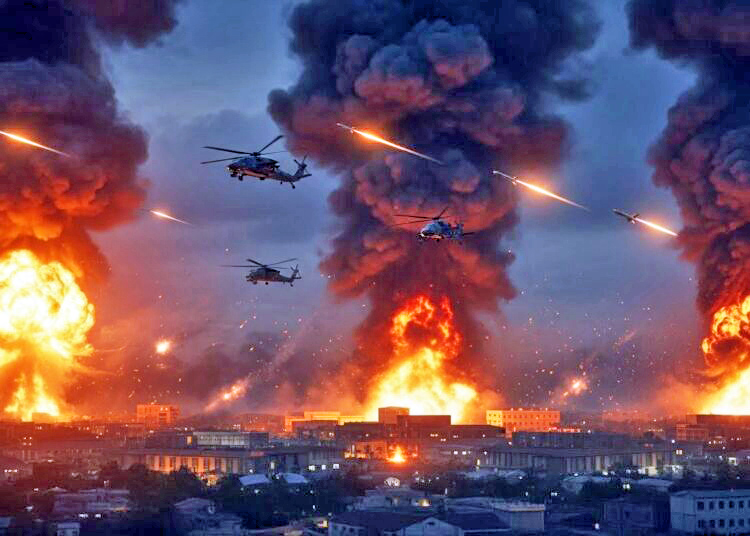
The attack carried out by United States special forces against Venezuela on 3 January, aimed at kidnapping the country’s ruling president and imprisoning him, represents – waiting to see what may occur in the future – the culmination of a series of US attacks directed, in one way or another, towards the control of this Caribbean country.
According to information known so far, US President Donald Trump is said to have warned Venezuelan President Nicolás Maduro in recent weeks that he was preparing to attack the country with the aim of getting rid of his government. The Venezuelan president is reportedly said to have rejected an offer of exile in Turkey and to hand over his post to one of the senior officials who stand below him in the governmental hierarchy. The pretext used by the United States to depose Maduro is the fight against drug trafficking (an updated version of the war on terrorism that led US troops to invade Afghanistan, Iraq and a whole series of other countries), because – always from the standpoint of the North American government – the Venezuelan president is alleged to lead an international cartel engaged in smuggling cocaine from South America into the United States and laundering the proceeds of this trade.
OIL… IS NOT EVERYTHING
Without it being possible either to deny or to confirm the truth of these claims (since, notwithstanding the idealisation of the Venezuelan regime promoted by certain American and European political currents, its bourgeois – and therefore criminal – nature predisposes it to, and enables it to engage in, any kind of business, however illicit), it is at the very least ironic that the United States, one of the most significant hubs of drug trafficking on a global scale, should attack another country on this pretext. Donald Trump himself, in his speech on that same 3 January, provided an explanation which, although incomplete and deliberately one-sided, gives a more realistic picture of the reasons behind the US attack and identified control over the Venezuelan oil industry as its ultimate objective.
 It
is well known that the United States and Venezuela have for decades been
engaged in a fierce struggle over the ownership of a substantial part of the
country’s oil infrastructure. In 2006 the government of Hugo Chávez
abolished the legal framework under which large oil companies operated in
Venezuela and enabled the state-owned company Petróleos de Venezuela SA (PDVSA)
to assume full control over extraction and the profits arising from the oil
trade, to the detriment of companies – mainly North American ones – that had
benefited from the so-called Oil Opening process (the policy of
opening up the oil market), which had allowed them access to Venezuelan
resources from the beginning of the 1990s. Since then, the United States has
demanded substantial compensation from Venezuela for this de facto
expropriation and has never ceased to consider the possibility of forcibly
regaining the privileged position its companies lost.
It
is well known that the United States and Venezuela have for decades been
engaged in a fierce struggle over the ownership of a substantial part of the
country’s oil infrastructure. In 2006 the government of Hugo Chávez
abolished the legal framework under which large oil companies operated in
Venezuela and enabled the state-owned company Petróleos de Venezuela SA (PDVSA)
to assume full control over extraction and the profits arising from the oil
trade, to the detriment of companies – mainly North American ones – that had
benefited from the so-called Oil Opening process (the policy of
opening up the oil market), which had allowed them access to Venezuelan
resources from the beginning of the 1990s. Since then, the United States has
demanded substantial compensation from Venezuela for this de facto
expropriation and has never ceased to consider the possibility of forcibly
regaining the privileged position its companies lost.
At present, Venezuela possesses the largest proven oil reserves in the world, estimated at approximately 300,000–303,000 million barrels, representing roughly 17% to 20% of global reserves. This places it in first position, ahead of Saudi Arabia and Iran. Some North American and international estimates even suggest that the actual volume of as yet undiscovered or difficult-to-extract reserves could be even higher (between 380,000 and 652,000 million barrels), although yields and economic viability remain matters of debate. A large share of Venezuelan oil, however, is very heavy and viscous (extra-heavy crude), which makes its extraction technically more demanding and financially more costly compared with lighter crude from other countries.
Oil accounts for approximately 90% of Venezuela’s export revenues and has historically been the backbone of the state economy. Production, however, is significantly below the potential of the reserves (currently around 900,000–1,000,000 barrels per day for export), representing less than 1% of global demand, primarily as a result of political instability, mismanagement and sanctions.
Chevron Corporation is the main US oil company operating in Venezuela, despite the long-standing sanctions imposed on PDVSA. On the basis of exemptions granted by the US government, Chevron has permission for limited extraction and exports, with these permits having been repeatedly reviewed in 2025 and, in some cases, withdrawn. Specifically, Chevron has been allowed to export Venezuelan oil despite the sanctions, but at the same time, its direct flow of money to the Venezuelan regime has been restricted because it is “politically sensitive”.
The gradual reduction of the importance of the United States in the Venezuelan oil industry has, in recent years, conversely led to the growing importance of trade with China. According to specialist sources, China imports approximately 921,000 barrels per day from Venezuela (80% of the country’s crude oil exports), while the United States imports only 150,000 barrels per day. In other words, in recent years there has been a shift in Venezuela’s strategic position: after decades of blockade and declining exports as a result of lower international demand, it has ceased to be a source of reserves for the United States and has become a source of reserves for China. Indeed, two oil tankers intercepted by the US Navy several days before the attack were reportedly heading for this Asian country, which in return provides Venezuela with cutting-edge technology, inputs for domestic industry, and so on.
Added to this is the commercial relationship – also regarded by Venezuela as preferential – that it maintains with Iran. Although it does not reach the scale of relations with China, it carries significant weight in the Venezuelan economy and provides relief in coping with the effects of the embargo imposed on Venezuela by the United States.
This is the core of the problem. The objective of the United States is clearly not the control of drug trafficking. Nor is it exclusively the takeover of the Venezuelan oil industry, which may be highly lucrative but without which the United States has managed to get by for two decades… The objective of the pressure exerted by the United States on Venezuela is twofold.
On the one hand, it seeks to restrict the Caribbean country’s trade relations with China and Iran, to prevent both the supply of undoubtedly very cheap oil to these two countries (which is of vital importance for the industrial expansion taking place in both) and payment for it in the form of military and industrial technology; this is therefore about consolidating influence in the Caribbean region, primarily against Chinese influence.
On the other hand, by making an example of Venezuela, it seeks to signal to other Latin American countries and bourgeoisies that, both economically and politically, it is reaffirming its domination over the subcontinent, as part of a kind of assertion of rights that it considers indisputable.
There is no need to go far back in time to find this dual objective explicitly formulated by the US government itself, since in the recently published National Security Strategy – the document setting out its political and military orientation for the coming years – the claim of the United States over South America as its own sphere of influence is explicitly stated. This is not merely an economic interest, not simply a claim to oil… what is at stake is the assertion of an entire political and military position. America – this must be clear to all the countries that make it up – is the private hunting ground of the United States. This does not mean that no other country may trade or defend partial interests in certain areas, but undisputed dominance is due to US imperialism.
THERE IS ALSO THE BOURGEOIS AND IMPERIALIST ORDER…
During the first years of Hugo Chávez’s government, in the midst of a global economic boom in which fuel consumption in all advanced capitalist countries and in a large part of those considered developing grew uninterruptedly, Venezuelan oil exports brought the state substantial profits. A large portion of these profits was used to relatively modernise the national productive apparatus, consolidating Venezuela as a regional economic power.
At the same time, a large-scale programme of social benefits for the proletariat and impoverished masses was launched: price controls on the basic consumer basket, construction of affordable housing, employment programmes, the promotion of literacy… Millions of oil dollars that filled the state coffers enabled economic and social expansion that went hand in hand with the global economic growth of the time, but this was only thanks to a thin thread – the export of a single commodity, oil.
Did the Chávez regime differ in this respect from other capitalist countries? Not at all. In practically all of Europe and North America, since the end of the Second World War, the bourgeoisie has allocated part of surplus profits – obtained first from post-war reconstruction and later from imperialist domination over the rest of the world – to maintaining a series of social absorbers that ensure a relative social peace based on a strict policy of collaboration between classes. The first years of the Chavista regime were not exceptional when considered in general terms. Only in the Latin American context, and especially with regard to Venezuelan particularities – where ruling bourgeois oligarchies have mercilessly exploited the proletariat and peasantry of the region and have not hesitated to plunge them into the most extreme hunger and misery – can one discern a certain difference.
The policy of conciliation that successive Chavista governments applied towards the proletariat and the poorest popular strata is inspired by the traditional mode of bourgeois rule in any of the central capitalist countries; there is nothing revolutionary about it. The fact that it sought the sources of funding for this policy in the nationalisation of key sectors, such as the oil industry, brought it into conflict both with the traditional Venezuelan bourgeoisie and with its North American patron. This conflict, which undoubtedly existed, must not, however, lead to the assumption that the extremely limited Chavista reforms had any subversive character. It is true that Chávez’s government confronted the Venezuelan oligarchy and the United States to the point that in 2002 there was an attempted coup aimed at overthrowing it. It is also true, however, that the failure of this attempt, due to pressure from popular masses in the streets, redirected existing tensions towards a consensus of relative, temporary and conditional truce: both the United States and the Venezuelan bourgeoisie accepted that only the Chavista regime was capable of controlling the social tensions created by decades of misery, and it quickly assumed the role of guarantor of the imperialist order in the country while at the same time allowing a new, numerous and particularly aggressive and greedy bourgeoisie to flourish around it, enabling it to enrich itself through new business and to penetrate all the recesses of the state structure.
The conflict of the governments of Hugo Chávez first and later Nicolás Maduro, both with the section of the bourgeoisie excluded from power and with the United States, cannot be understood as the struggle of a revolutionary regime (not even reformist in the strict sense!) against reactionary forces, but rather as an inter-bourgeois struggle in which the various factions fought to win the support of proletarians and “the people” in general: some defending social gains financed by oil revenues, others democracy and the fight against the growing corruption of the new bourgeoisie and the army, which, as the social situation deteriorated, became the main guardian of order.
In the midst of this struggle, the capitalist crisis of 2008–2012, the end of unlimited demand for oil and the decline in revenues from its sale led to the economic, political and social crisis of the Chavista regime, which increasingly relied on the armed forces and was saved – temporarily – only by its inclusion in the trade bloc formed by China, Russia, Iran and other less significant countries.
The reality is that, at the moment when the United States, in line with the political and military turn of recent years, doubled its attacks against Venezuela in order to wrench it out of this economic sphere of influence, the Venezuelan state could not exist without the new Chavista bourgeoisie (the notorious bolibourgeois – the “Bolivarian bourgeoisie”), because it now represents the principal force of order in the country and the only one on which the US imperialist order can rely. The opposition (today Machado, previously Guaidó… and many others) has shown itself to be completely incapable of guaranteeing bourgeois order. Not because Maduro’s government has maintained the popular support that characterised the first Chávez governments, but because the state apparatus built partly on that basis is controllable exclusively by this Bolivarian bourgeoisie, which has managed over twenty years to seize control of the army and the other instruments of power.
Trump himself acknowledged this when he declared that the opposition to Maduro, led by Corina Machado, does not enjoy the support of the Venezuelan people – that is, it lacks the strength necessary to take over the state because it is unable to unite in this direction the various bourgeois forces (one of which is US imperialism) that converge there. By contrast, Maduro’s deputy Delcy Rodríguez, representative of that “corrupt narco-state” which the United States uses to describe Venezuela, would be, for the Trump administration, “someone trustworthy”.
There is no doubt that the United States will oversee a transition in Venezuela aimed at opening the doors of the state to certain bourgeois factions that are currently excluded. The main objectives of this change will be to remove Venezuela from the sphere of influence of China, Russia and Iran, while at the same time allowing US companies to take control of the oil industry. The manner in which this will be carried out cannot yet be foreseen, as it forms part of an imperialist game of much wider scope affecting both the Latin American region as a whole and the rest of the world. All that can be said is that it will be a transition fully within the framework of the bourgeois order, a reshuffling of bourgeois forces, and that it will very probably leave Chavista structures in power, which this time will openly align themselves with… the United States.
A WARNING TO THE PROLETARIAT
From the late 1980s until 2002, the Venezuelan bourgeoisie and US imperialism were fully aware that Venezuela stood in the furnace of popular discontent and anger. Two decades of almost uninterrupted crisis, drastic deterioration of living conditions, falling wages, and so on ultimately triggered popular uprisings such as that in Caracas in 1989 (the so-called “Caracazo”).
The 1992 coup, led by a group of officers headed by Hugo Chávez, was an expression of this discontent, which certain sectors of the army, the trade-union bureaucracy and so on believed could only be managed through a nationalist reform programme. As stated above, after Chávez’s accession to power and the launching of the Fifth Republic, and especially after the 2002 coup showed that the traditional bourgeoisie had only a very limited capacity to exercise power, both it and the US bourgeoisie accepted a nationalist type of government in the country.
Since then, this government has used every means to build state and para-state structures capable of co-opting certain sectors of proletarian and popular origin (from former guerrilla currents to the trade unions, of which Maduro was a leader) in order to stifle any germ of independent class struggle. Towards the rest of the proletarians, whenever they advanced their demands, even on purely economic terrain, the governments of Chávez and Maduro always responded with the harshest repression.
The Venezuelan proletariat, after decades of terrible suffering, after abandoning any hope of lasting reforms, however small, and after bearing on its shoulders the weight of the economic crisis afflicting the country, will now pay the price for the “transition” promised by the United States and accepted by the Venezuelan bourgeoisie of both camps. The strength it possessed in 1989 or in 2002 – even though at those moments it was conditioned by a purely spontaneous character or by co-optation by the regime – has now disappeared. This was the main victory of Chavismo and its “twenty-first-century socialism”: they halted any independent impulse on the part of the working class, blinding it with democratic illusions based above all on improved material and social conditions for a section of the proletariat transformed into a “labour aristocracy”, and with petty-bourgeois “anti-imperialism”, which keep it paralysed and, for the time being, incapable of any response.
If US imperialist aggression constitutes a warning to Latin American bourgeoisies about what they can and cannot do in terms of political and economic alliances, for proletarians in all the countries of the region it represents more than a threat – it is a tangible reality of the future that awaits them. Inter-imperialist tensions force a reorganisation of the spheres of influence of the major powers and an intensified exploitation of the resources located within them. This includes labour power, the principal resource that capitalism requires in order to function. Under US domination, which once again enforces its claims militarily, the proletarians of Latin America face a clear future: greater exploitation by their own bourgeoisie and by American imperialism, worsening living conditions, systematic repression, death… The social disciplining of the proletariat is an indispensable condition for the imposition of the economic demands of the bourgeoisie. And the Venezuelan bourgeoisie, Bolivarian and opposition alike, will become its principal supports.
A few weeks ago, when military tensions between the United States and Venezuela were rising, without the outcome of the situation being clear, we wrote a few words to which today we have nothing to correct or add.
“Proletarians in the imperialist countries must oppose the campaigns against Venezuela, as well as those targeting other countries; economic sanctions, blockades, diplomatic pressure, “humanitarian” interventions, or military operations are part of the arsenal used to establish or reinforce imperialist domination over weaker countries in order to obtain advantages of all kinds. Imperialist domination must be fought without hesitation, not in the name of the deceptive, bourgeois-democratic ideology of equality among nations and respect for “international law,” but because such domination strengthens the class enemy and makes proletarian struggle in the imperialist countries more difficult, by facilitating the corruption of the “labor aristocracy.” Any weakening of the power of the imperialist bourgeoisie is a positive factor in the class antagonism with it; at the same time, any weakening of imperialism eases the pressure on proletarians in dominated countries, who are always the first victims of imperialist actions. Class solidarity with proletarians in dominated countries is therefore an imperative of proletarian struggle in the imperialist countries, and not a vague moral duty of humanitarian charity.
Proletarians in the imperialist countries, and in particular U.S. proletarians, must show this solidarity not only by refusing to participate in the campaign against Venezuela, by denouncing the rhetoric about the war on drugs, democracy, and human rights — rhetoric that serves only to mask sordid imperialist interests — but also by opposing government measures against legal and illegal immigrants, Venezuelan and otherwise. Recently, hundreds of thousands of immigrants, including 600,000 Venezuelans, have lost their right of residence in the United States, condemning them to illegality. Solidarity with immigrant proletarians is essential to strengthen the proletariat as a whole against a bourgeoisie that does not hesitate to use force to defend its interests, inside and outside its borders.
Faced with rising tensions between states, the economic crisis, sanctions, misery, and the threat of war, the proletariat has only one path: that of international class struggle. This means: no “tactical support” for the Maduro government; a total break with all common fronts with the bourgeoisie, whether patriotic, democratic, or “anti-imperialist”; rejection of all bourgeois camps: Maduro, the liberal opposition, imperialist governments, regional blocs; revival of class struggle independent of the parties and unions that defend the bourgeois order; work toward the reconstitution of an international communist movement unifying the struggles of proletarians in Venezuela, the Americas, Europe, Africa, and Asia.
Neither Washington’s threats, nor Caracas’s patriotic speeches, nor the promises of the bourgeois opposition can offer a way out for the exploited. All these camps defend private property, wage labor, generalized competition between companies and states — that is, the very foundations of capitalist exploitation.
Venezuela’s proletarians must refuse to die for the fatherland; proletarians in the United States and Europe must refuse to support their sanctions, their fleets, their military bases. Everywhere, it is a matter of taking up again the broken thread of Liebknecht, Lenin, and the first two years of the Third International: the main enemy, for every proletarian, is in his own country: his own bourgeoisie and his own state.
Only by uniting their struggles across borders, on the basis of a communist program for the destruction of capitalism and class society, can the workers of Venezuela and the rest of the world escape the deadly trap in which competing bourgeoisies seek to imprison them.”
US troops out of Venezuela!
Against imperialist war – proletarian class war!
The enemy is at home: it is the bourgeoisie!
January 4, 2026
International Communist Party
Il comunista - le prolétaire - el proletario - proletarian - programme communiste - el programa comunista - Communist Program
www.pcint.org
Top

